Respected guests, dear Lea Ypi
Përshëndetje, Mirë se vini në Shkup, Welcome to Skopje
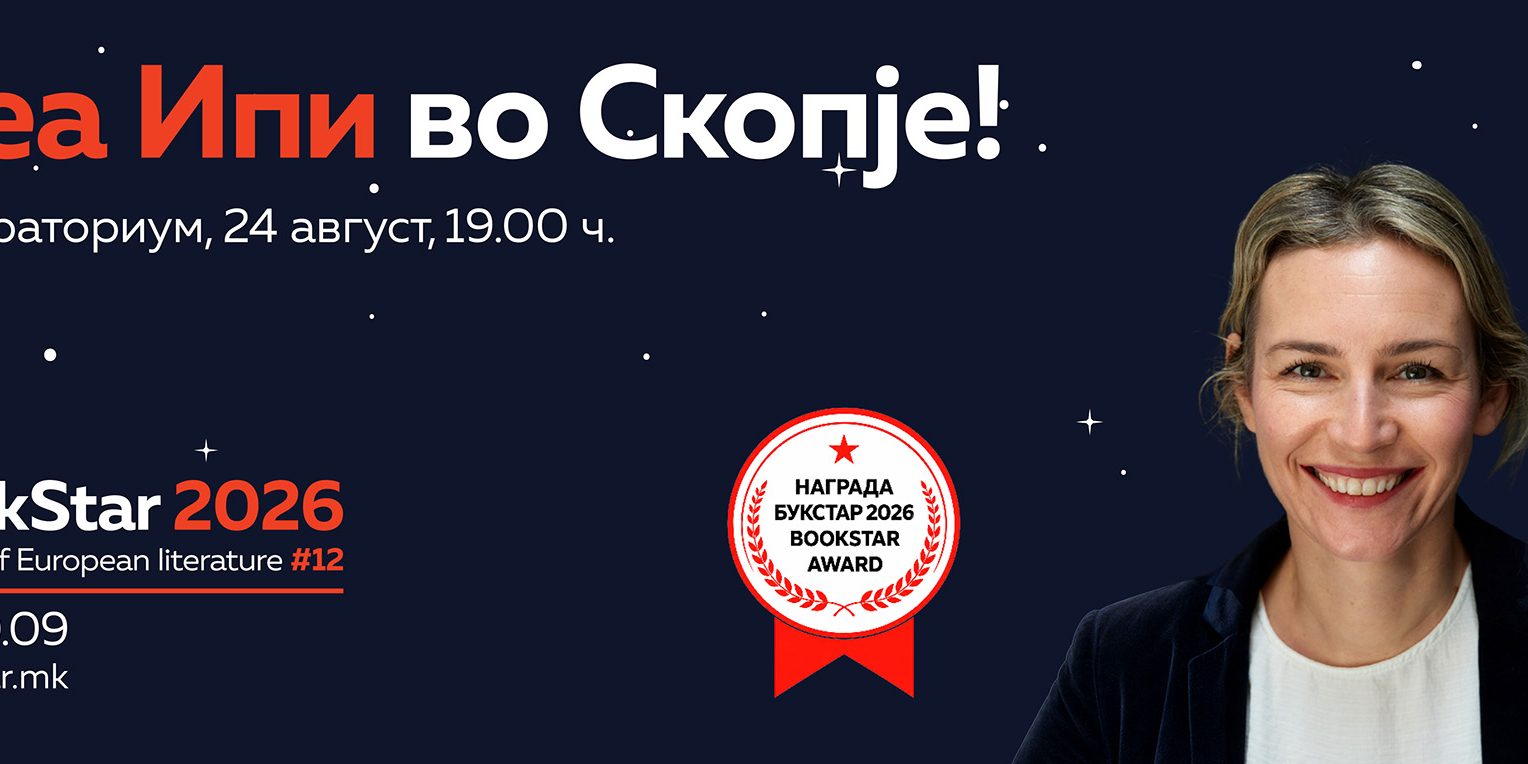
This year's winner of the 2026 BookStar Award, at the international BookStar literary festival, dedicated to the topic "FREE AT LeAST!" is the professor and philosopher Lea Ypi, for her memoir originally titled "Free: Coming of Age at the End of History", published in English in 2021. The Macedonian translation, „Слобода, созревање на крајот на историјата“, ("Freedom, Maturation at the End of History"), made by Kalina Maleska, was published in 2024 by the publishing house "Ili-Ili".
It is an honor and pleasure for me to have the opportunity to say a few words about Lea Ypi's memoir "Free: Coming of Age at the End of History" which, in addition to this year's Bookstar Award, has also won the Ridenhour Book Prize for Truth Telling (2024), the Ondaatje Prize from the Royal Society of Literature for the best work [fiction, nonfiction, poetry] (2022), the Lumo Skëndo Prize for the Best Work in Albanian Nonfiction (2022), and the Slightly Foxed First Biography Award (2022).
Writing about freedom is a challenge. Not because not enough has been written about freedom, but precisely because so much has been written and said about freedom. In the history of human thought, the concept of freedom is one of those that carries so many meanings, but also so many hopes, and just as many contradictions. From ancient philosophy linking freedom with the participation of citizens in political life, through the question of free will, to the Enlightenment idea of autonomy and the right of the individual, freedom is constantly being questioned and redefined. In modern thought, it becomes even more complicated: as freedom FROM constraints and freedom TO act/or freedom to act; as the possibility of choice, but also the responsibility for that choice; as political action, but also as a question of how much our lives are shaped by social relations and power structures.
But the complexity of freedom does not stem only from the long history of attempts to define, describe, clarify, and delimit it. It also stems from the fact that freedom is never the same for everyone. Not only do different societies and political systems understand and thereby define freedom differently, but also because each person has their own understanding of what it means to be free, which they are also very likely to change over the course of their lives.
From Plato, Aristotle, Augustine, Hobbes, Locke, Rousseau, Kant, Hegel, Marx, Nietzsche, to Berlin, Sartre, Arendt, Foucault, Lea Ypi, in an elementary but deeply informed way, portraying the maturation of a girl in Albania in the complex political, social and ideological changes of the late 20th, and early 21st century, builds on this long and certainly incomplete series of understandings of freedom.
Lea Ypi's memoir "Free: Coming of Age at the End of History" does not offer a single, final and universal definition of freedom. On the contrary, the book "Free" shows how differently freedom can be experienced within a family, in a country and in a historical time.For Nini, for the father, for the mother and for Lea herself, freedom has different faces. They have different attitudes towards freedom because they have different life experiences, different memories, a different past and even a present, different fears and different ideals. In the memoir "Free" we will encounter a multitude of understandings of freedom, some deeply serious, others naive and unformed, still others even ironic. In "Free" freedom is not an abstract philosophical concept, but something that each character lives, imagines and rethinks, desires and loses in a different way and several times. Ypi's memoir reminds us that freedom is not a state that is achieved once and then possessed forever. It is a constant search, a constant re-examination, and a constant redefinition. In that sense, the search for freedom is like the search for the Holy Grail, a search that never ends. Freedom, so desired, yet almost elusive.
The memoir “Free” is not only significant because it poses deeply philosophical, political, and essentially meaningful universal questions about freedom in a very receptive, natural, and palatable way. The memoir is also significant because it reminds us that freedom never exists outside of history, outside of context. We cannot understand what freedom means to a person if we do not understand the world in which that person lives. Context is important, perhaps even crucial, to understanding anything, including freedom.
That is why Lea Ypi's memoir has a special significance.It brings a small part of the Balkans closer to the world, a region that has often remained on the margins of broader European and world narratives. Through the intimate story of one family, Ypi places her native Albania in the context of the complex political transformations and traumatic events that she, her family and those close to her have gone through. She shows that great history does not happen only in textbooks, archives and political speeches. It happens in homes, in family conversations, in silences, in fears and in childhood memories.
For readers in Macedonia, “Free” has an additional meaning. Albania is our neighbor, but neighborhood does not always equal familiarity. How much do we really know about the past of the country that is so close to us? How much do we know about its political and social transformations, its traumas, its transition? And how much do we know about the differences, but also the similarities, between our experiences?
By trying to understand Albania, we may be able to understand ourselves better. The book invites us to get to know the Other, but also to realize that such getting to know is inevitably a form of self-knowledge. If we want to better talk about our own past, our own traumas, and our own transition, we need to learn to listen to other stories from the region we live in. It is important to know about each other, because only in this way can we overcome simplified representations of our neighbors, but also of ourselves.
And here I would mention Nini, Ypi's grandmother, who says (I will paraphrase), when we don't know how to think about the future, we have to return to the past (39). Not to stay in it, but to better understand what of it still lives in us and why.
The motto of this year’s festival, Free at l(e)ast!, asks us whether we are finally free and what does freedom serve us, what to do with it. Lea Ypi’s memoir “Free” suggests that we should ask ourselves what we actually mean when we say we are free or when we say we want to be free? Ypi’s book does not offer us freedom as a simple answer, but as a question that we must constantly, again and again ask ourselves. Because it reminds us that freedom is not just an idea from philosophy books, nor just a political ideal. It is something deeply personal and at the same time socially and contextually dependent, something that we must search for, question and reinvent, in the world, in others and in ourselves.
Ivana Trajanoska